

Babcia
Babcia.(pronounced bob-cha) - The Polish word for grandmother.
Each family I meet teaches me something. I am invited into moments that are intimate, sacred, and deeply human, and I never take that invitation lightly. Still, there are rare times when a family reaches me in a way that stays, when their presence settles into me quietly and permanently. This was one of those times.
It began with a text message from a woman who had been referred to me. We exchanged a few messages, enough for me to sense urgency, care, and a deep concern for doing this well. By that afternoon, we decided to meet over Zoom. That was where I first saw her. That was where I met her brother, too. And that was where I began to understand the weight she was carrying.
Her mother had just started hospice. Her mother was dying. She needed someone to tell her what she could do, what to expect, how to prepare, and how she could help her family through this.
She was holding two roles at once, daughter and caregiver, and doing both with remarkable steadiness. On Zoom, I could see the tiredness in her eyes, the kind that comes from love layered with responsibility. Even then, she wasn’t focused on herself, she was thinking about her husband, their kids, her brother, his wife, and their kids. She wanted everyone supported, especially the kids. She wanted to make sure they were cared for in this. From my perspective, she was already following in her mother’s footsteps... something I learned later.
This family is Polish, and the woman they were preparing to say goodbye to, was called Babcia. She was a grandmother to many, some were her daughter’s children, some were her son’s, she was unmistakably the center of them all. She wasn’t only the grandmother, she was also the matriarch, the one who gathered people without effort, the one around whom everything quietly organized itself.
She had lived in her home since the 70’s. This was the house, the place where holidays happened, where people returned to, and where life unfolded again and again. Family by blood, by marriage, by friendship, this home held all of it. Long before her death approached, her legacy was already living in those walls.
After that first Zoom call, her daughter and I continued to text. We talked about what the coming days might look like, about death and about saying goodbye. We talked about the kids, young adults, each of them navigating this in their own way, all of them deeply attached to their grandmother. I had agreed to come the following day to help support them, but things changed, her condition shifted more quickly than expected, and she asked if I could come that day instead. I said yes.
The moment I walked through the door, I felt it, the house was alive with emotion. I could feel the stories, and the layers of laughter, hardship, resilience, and love. There was a sense of foundation there, something strong and steady beneath the grief. I felt deeply honored to be welcomed into it.
There were many people in the house. Family in every sense of the word. Everyone had shown up, not because they felt obligated, but because they wanted to be there for her and for one another. Even the three dogs seemed to know something important was happening. They moved differently, staying close, offering comfort in the quiet, instinctual ways animals do. It felt like everyone, human and animal alike, was trying to take care of everyone else.
When I first saw her, I knew she was close, hours, maybe a day or two. And I could see how differently each person was holding that truth, especially the kids. Their love for her was clear. They were tender and brave all at once, allowing themselves to feel, to cry, to be seen, without hiding the depth of their connection to her. There was nothing performative about it. It was honest and incredibly beautiful.
I wanted to offer them something that honored both their individual relationships with her, as well as their shared love for her, so I invited them to participate in my embroidery thread ritual. If they were skeptical, I didn’t notice it, and everyone agreed to participate. I recognized immediately that they would each make this their own and I loved that about them.
I watched as they chose their colors of thread. I watched their faces as they listened, and as they imagined what this would look like. One by one, they went into her room alone. Each tied a strand of embroidery thread onto her left wrist, securing it with four knots. Each had their own private moment with her, leaving her with a private and heartfelt message to take with her. Each came out in tears. And yet, there was something grounding in it, something that allowed them to express their grief without being consumed by it.
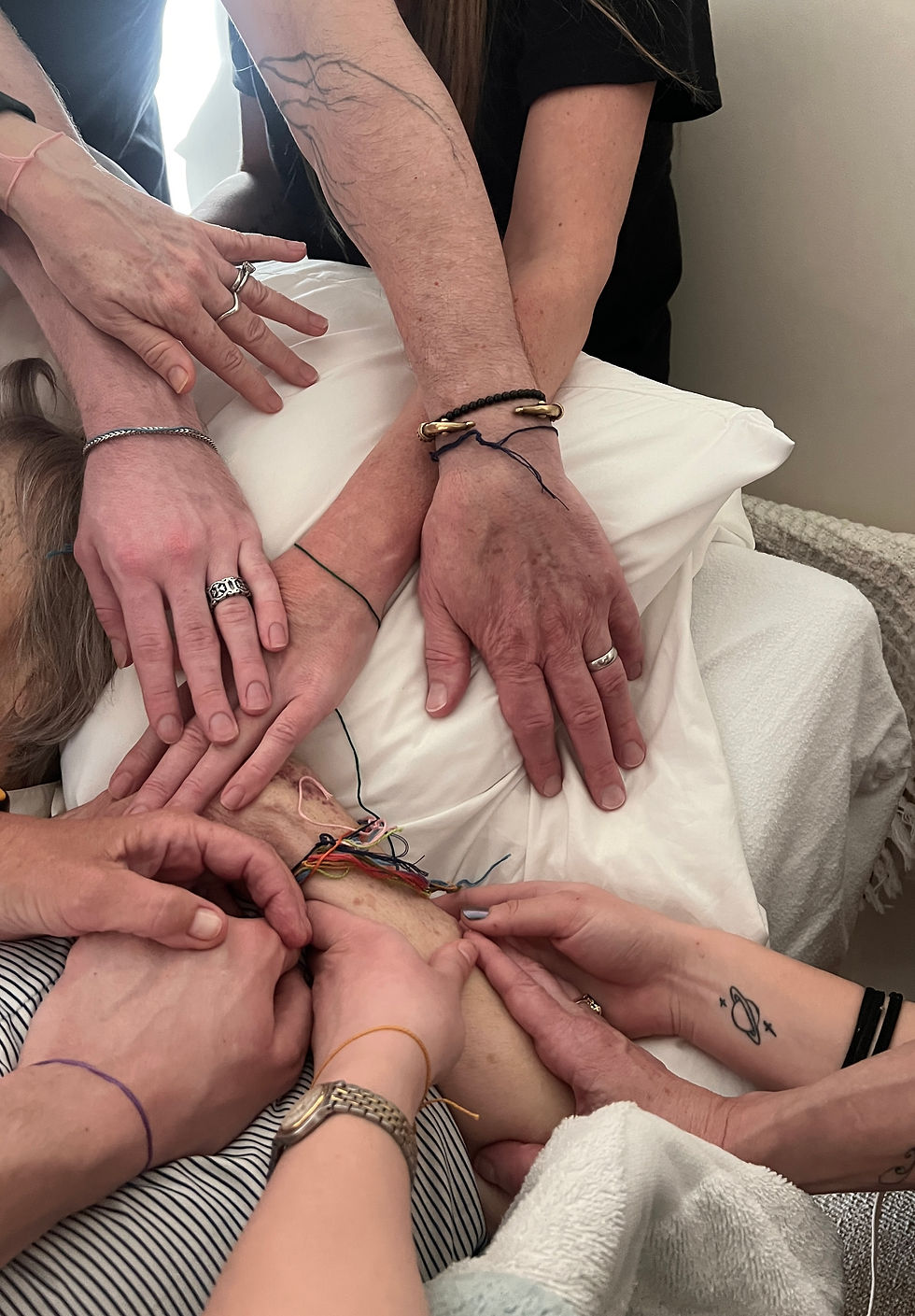
When they were finished, they all gathered in her room to tie the remaining threads around their own left wrists, helping one another with the knots. It was symbolic and sacred, quiet and profoundly meaningful. I felt honored to witness it, and to photograph it, knowing these images would one day matter deeply.
Then they all placed their hands near the many strings tied to her wrist, holding up their own so the threads mirrored one another. I felt tears rise and held them back, this was not about me, this moment belonged entirely to them. Still, I knew I was witnessing something rare.
Later, when she became briefly agitated, we spoke gently about comfort and medication. Her family was already providing beautiful care, following the guidance of their hospice team with intention and love. My role was simply to support what was already so clearly present.
Eventually, I slipped out quietly, giving them space to be a family.
She died the next morning.
Their grief will be real and lasting. But so will her presence. She leaves behind a legacy that few do, a legacy of gathering, of deep connection, of love that multiplies rather than divides. I was with her briefly, I only spent a few hours with her and her family. But I heard the stories, and I saw their faces when they spoke her name. She lived fully. She loved attention. She gave pieces of herself so freely that each person carried something different, something uniquely theirs.
Yes, she died, and yet, she will never die. She will live on in their stories, in their laughter, in the way they continue to look out for one another. They will say her name. They will feel her presence in the rooms she once filled.
Her daughter, the woman who first reached out to me, will likely feel this loss most acutely. Balancing caregiver and daughter leaves little room for rest. She may not see it yet, but she is her mother’s reflection. Even in her hardest moments, she was watching out for everyone else. Her mother’s final gift was allowing herself to be cared for, and in doing so, she quietly passed the role of matriarch to her daughter. And what gives me hope is this: I believe this family will care for her, too. I saw it. I felt it. They know how to hold one another.
This was a house filled with people honoring their own experiences while remaining deeply attentive to everyone else’s. I don’t see that often. And perhaps that’s why this story lingers, because it surprises, and it invites a quiet kind of envy, and at the same time, a deep gratitude for knowing that this kind of love exists at all.
Babcia was unique, and what she leaves behind is extraordinarily beautiful.
xo
Gabby
I was given permission by the family to share their story and the photo.



Comments